
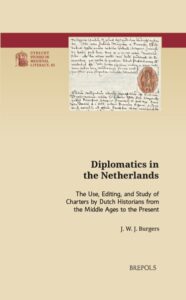
J.W.J. Burgers, Diplomatics in the Netherlands: The Use, Editing, and Study of Charters by Dutch Historians from the Middle Ages to the Present (Turnhout, 2025: USML 63), xxviii + 737 pp. ISBN 978-2-503-61753-4.
Charters and other administrative texts have long had the full attention of medievalists as primary sources in their historiographical work. This also applies to scholars from the Netherlands. Ever since the late Middle Ages, they recognised the value of these sources, included them as testimony in their historiography and gradually began to realise that charters and other documents required a specific form of textual criticism and a special way of editing. In this, Dutch historians usually followed developments abroad. Sometimes, as in the early seventeenth century, they were ahead methodologically, but for long periods they depended for new insights on developments elsewhere. This was especially true in the nineteenth century, when scientific diplomatic methods and editing techniques emerged which would only be introduced and applied in the Netherlands in the next century. In the twenty-first century, Dutch scholars are fully participating in the ‘digital turn’ that is creating new research tools in diplomatics.
Preface, Glossary, Abbreviations, List of Figures
Introduction
1. Late Medieval and Early Humanist Historiographers, 1280–1517
Charters in Medieval Chronicles from Holland and Utrecht: Chronicon Egmundanum, Rijmkroniek van Holland, Wilhelmus Procurator, Johannes Beke, and Johannes a Leydis
The Beginnings of Diplomatic Criticism: Willem Heda
Tables
2. City Secretaries, Civil Servants and Humanist Historians, 1470–1620
Local Historiography in the Towns
Administrative Collections of Documents
Humanist Historiographers
3. The Antiquaries: Arnoldus Buchelius and Petrus Scriverius, 1590–1660
Arnoldus Buchelius
Petrus Scriverius
4. Historians, Noblemen, Civil Servants and Charter Books, 1600–1660
Historiographical Works Including Documentary Evidence
Urban Historiographies
Charters in Genealogical and Historiographical Research on Noble Families
Editions of Charter Books
5. Historians, Collectors and Editors, 1644–1780
Antiquaries: Collectors, Transcribers, and Editors of Charters for Genealogical and Historical Research
Editions of Diplomatic Sources: Books of Placards and Charter Books
Adriaan Kluit
6. Historiography as a Profession: The Nineteenth Century
The Edition of Diplomatic Sources
Lists of Regests
Auxiliary Sciences: Diplomatics
Auxiliary Sciences: Palaeography
7. The Emancipation of Diplomatics: The Twentieth Century
Diplomatic Research in the First Half of the Century: Otto Oppermann
Charter Books and Other Charter Editions
Diplomatic Research in the Second Half of the Century
Palaeography
Conclusion
Epilogue: Diplomatics 2.0: The Twenty-First Century
Traditional Diplomatics
Digital Diplomatics
Summary
Bibliography
Index